ShamsVision shines a light on the shadow half of Saudi consumer goods: the roughly 200,000 independent stores that make up the large majority of Saudi grocery outlets and that nobody measures.
memo
3. Detailed Memo
ShamsVision
ShamsVision shines a light on the shadow half of Saudi consumer goods: the roughly 200,000 independent stores that make up the large majority of Saudi grocery outlets and that nobody measures.

RoundEarly Seed
AskUSD 1M to 1.5M
DateJune 2026
Cover
Cover
ShamsVision shines a light on the shadow half of Saudi consumer goods: the roughly 200,000 independent stores that make up the large majority of Saudi grocery outlets and that nobody measures.
M 01 / 16
01 of 13
Problem
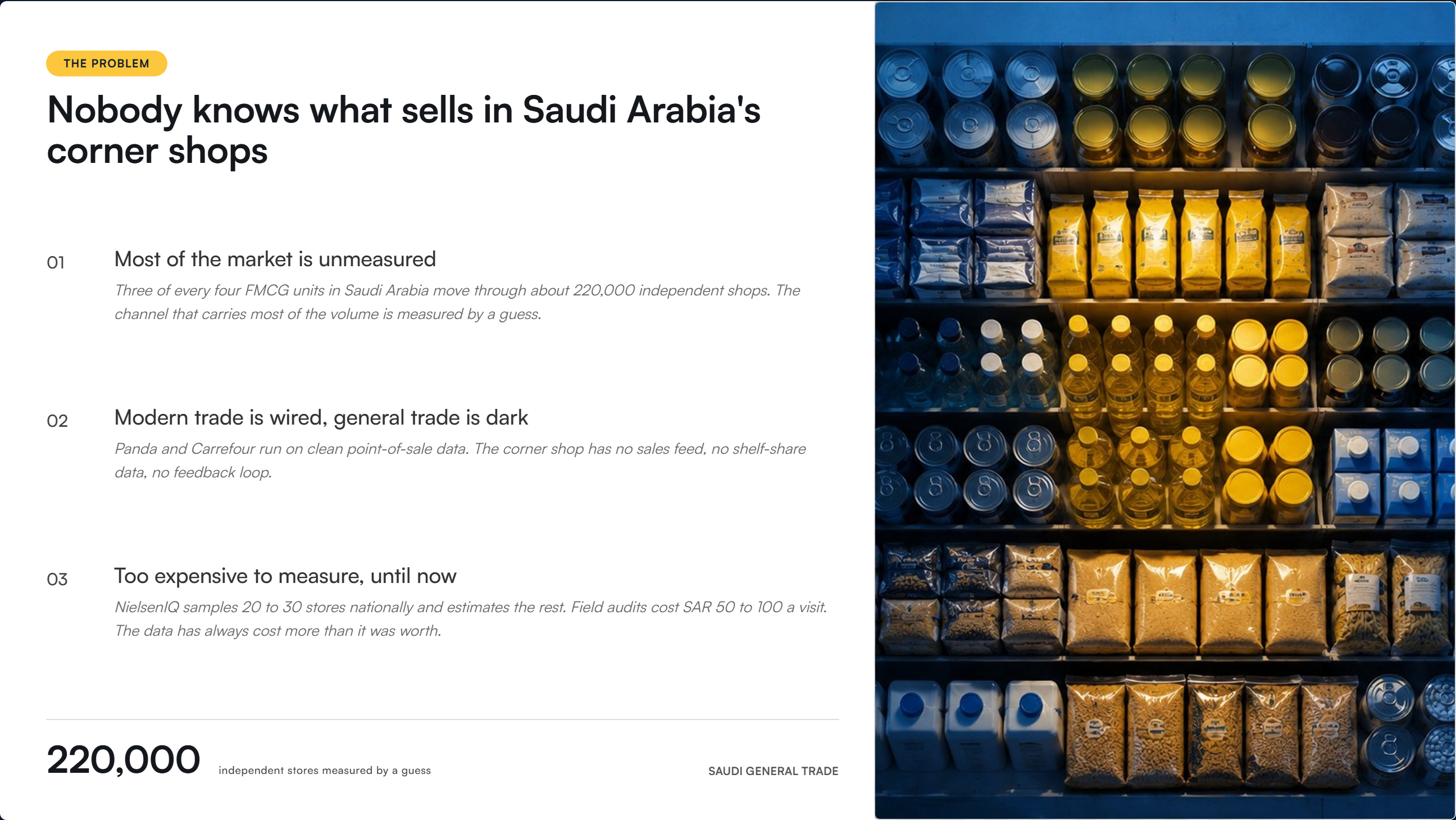
Nobody knows what sells in Saudi Arabia's corner shops.
Tens of thousands of independent baqala shops make up the large majority of Saudi grocery outlets, and general trade still moves nearly half of FMCG by value (Kantar). They sit between the brand and the customer for most of the market. The big chains run on point-of-sale data. The corner shop has none.
There is no shortage of FMCG data in Saudi Arabia. <a href="https://nielseniq.com">NielsenIQ</a>, <a href="https://traxretail.com">Trax</a> and <a href="https://channelplaymiddleeast.com">Channelplay</a> all serve the chains. None of them measures general trade, because at SAR 50 to 100 a store visit the data has always cost more than it was worth.
Asmaa saw it from inside <a href="https://www.loreal.com">L'Oreal</a>: prime shelf at the chains because the numbers justified the spend, and nothing for the corner shop because no numbers existed. Solve the cost of collection and the whole channel opens up.
Nobody knows what sells in Saudi Arabia's corner shops.
Tens of thousands of independent baqala shops make up the large majority of Saudi grocery outlets, and general trade still moves nearly half of FMCG by value (Kantar). They sit between the brand and the customer for most of the market. The big chains run on point-of-sale data. The corner shop has none.
There is no shortage of FMCG data in Saudi Arabia. NielsenIQ, Trax and Channelplay all serve the chains. None of them measures general trade, because at SAR 50 to 100 a store visit the data has always cost more than it was worth.
Asmaa saw it from inside L'Oreal: prime shelf at the chains because the numbers justified the spend, and nothing for the corner shop because no numbers existed. Solve the cost of collection and the whole channel opens up.
M 02 / 16
02 of 13
Solution
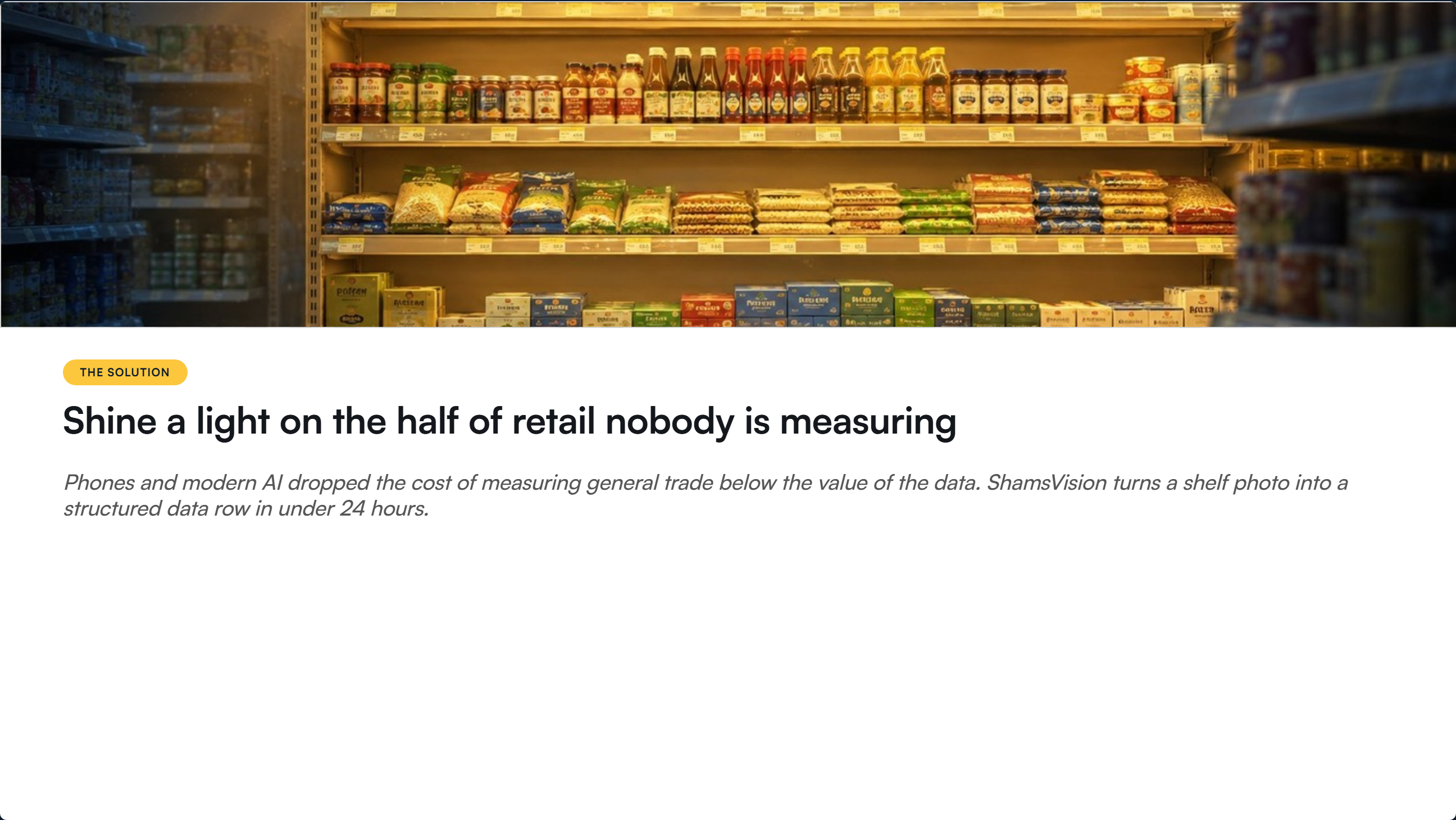
Shine a light on the half of retail nobody is measuring.
Two things changed. Every clerk and driver now carries a smartphone camera, and in 2026 AI can read a crowded corner-shop shelf at 75 to 85 percent accuracy today, with a clear path to the 95 percent enterprise buyers need.
ShamsVision captures shelf photos, checks where and when each was taken, reads the products and prices with AI, and shows the buyer a dashboard within 24 hours. The cost starts near SAR 10 a visit and falls toward SAR 1 as the crowd layer scales. Old field economics never got below SAR 50.
Modern trade is the well-lit half. General trade is the shadow half, where the real Saudi basket fills up. Phones plus AI dropped the cost of measuring it below the value of the data, and that flip is the whole company.
Shine a light on the half of retail nobody is measuring.
Two things changed. Every clerk and driver now carries a smartphone camera, and in 2026 AI can read a crowded corner-shop shelf at 75 to 85 percent accuracy today, with a clear path to the 95 percent enterprise buyers need.
ShamsVision captures shelf photos, checks where and when each was taken, reads the products and prices with AI, and shows the buyer a dashboard within 24 hours. The cost starts near SAR 10 a visit and falls toward SAR 1 as the crowd layer scales. Old field economics never got below SAR 50.
Modern trade is the well-lit half. General trade is the shadow half, where the real Saudi basket fills up. Phones plus AI dropped the cost of measuring it below the value of the data, and that flip is the whole company.
M 03 / 16
03 of 13
Product
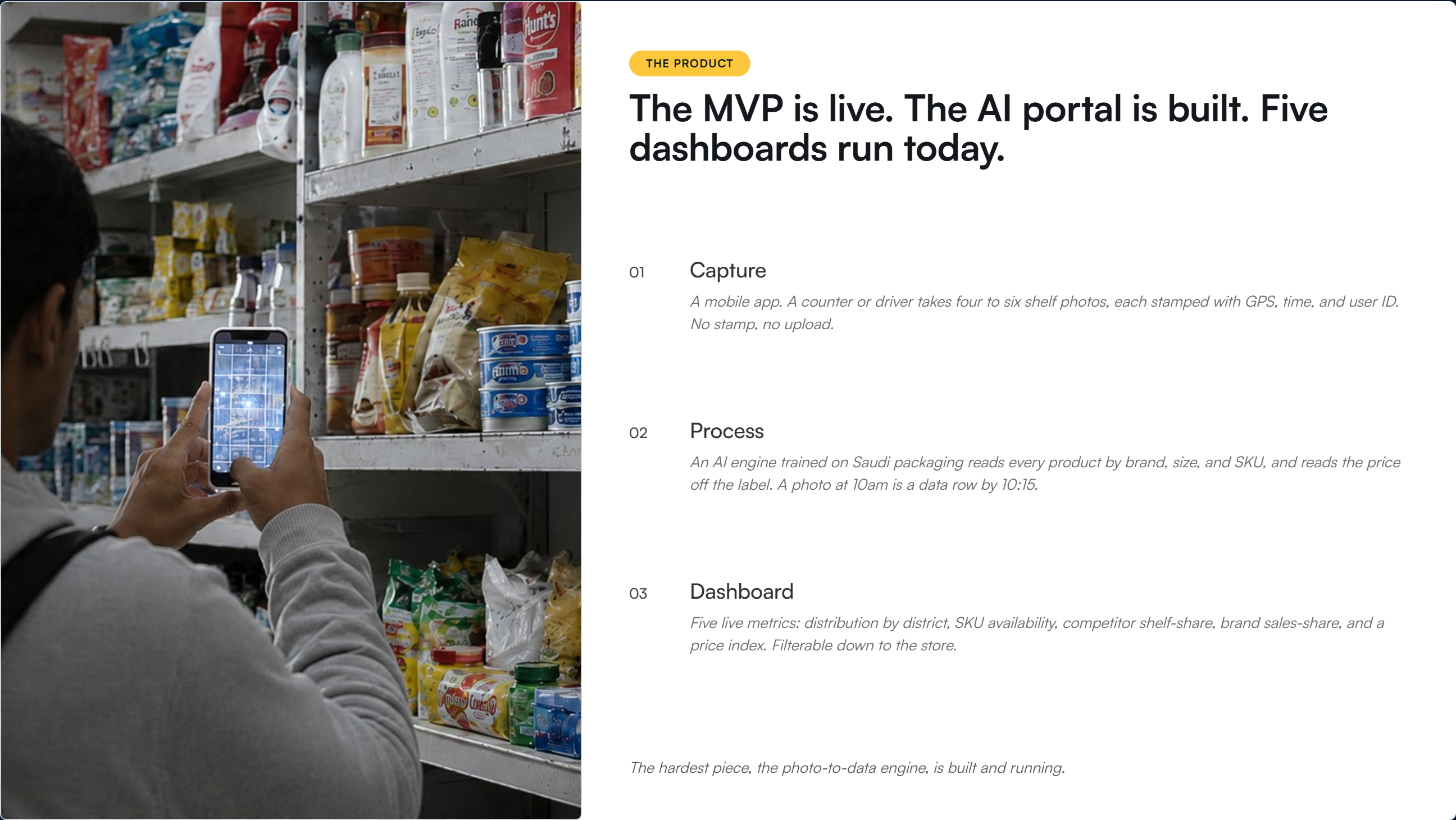
The MVP is live. The AI portal is built. Five dashboards run today.
Three layers. A mobile app captures four to six shelf photos, each stamped with GPS, time and user ID, or it is rejected. An AI engine trained on Saudi packaging reads every product and price. A dashboard shows distribution, stock, competitor presence, brand coverage and a price index, down to the district.
Accuracy on canned tuna and chips is already high enough to ship, with a daily QA team pushing fixes back into the model. Cosmetics and pharmacy come next.
It is not finished. Dashboard V2 adds shelf-share and sales-share, real-time alerts, an executive scorecard and a recommendation engine, and local hosting lands before the first enterprise contract. The hard part, turning a photo into data, already works.
The MVP is live. The AI portal is built. Five dashboards run today.
Three layers. A mobile app captures four to six shelf photos, each stamped with GPS, time and user ID, or it is rejected. An AI engine trained on Saudi packaging reads every product and price. A dashboard shows distribution, stock, competitor presence, brand coverage and a price index, down to the district.
Accuracy on canned tuna and chips is already high enough to ship, with a daily QA team pushing fixes back into the model. Cosmetics and pharmacy come next.
It is not finished. Dashboard V2 adds shelf-share and sales-share, real-time alerts, an executive scorecard and a recommendation engine, and local hosting lands before the first enterprise contract. The hard part, turning a photo into data, already works.
M 04 / 16
04 of 13
How it works
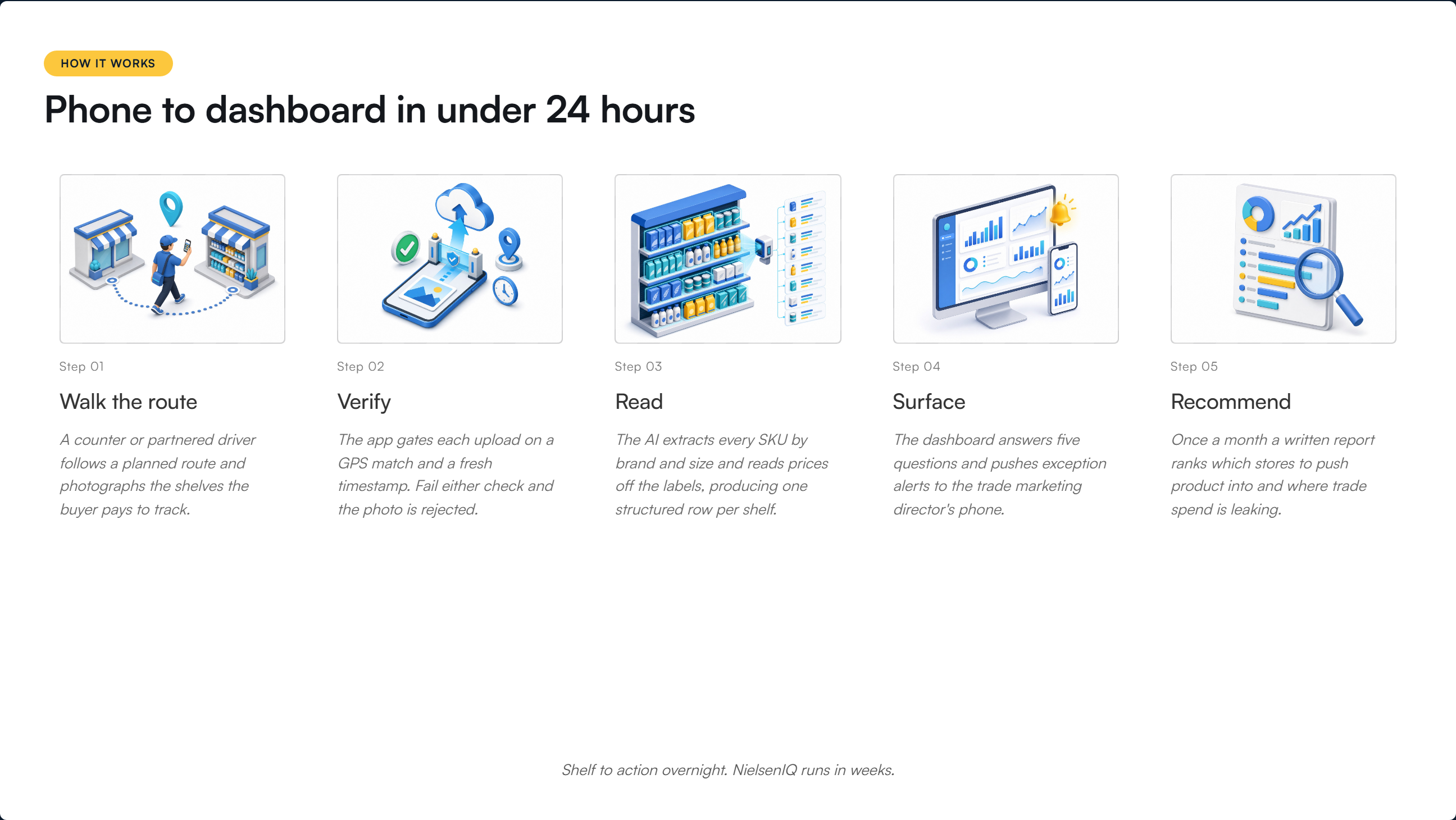
Five steps. Phone to dashboard in under 24 hours.
A counter or partnered driver walks a planned route and photographs the shelves the buyer pays to track. The app checks the GPS matches the store and the timestamp is fresh, or it rejects the upload. That check is why the crowdsourced model can scale.
The AI reads every product and price into one row per shelf. The dashboard answers five questions and alerts the trade marketing director when something changes. Once a month a short report says which stores to push and where spend is leaking.
Any row traces back to a specific photo at a specific place and time, which is what enterprise procurement requires. Shelf to action overnight. <a href="https://nielseniq.com">NielsenIQ</a> runs in weeks.
Five steps. Phone to dashboard in under 24 hours.
A counter or partnered driver walks a planned route and photographs the shelves the buyer pays to track. The app checks the GPS matches the store and the timestamp is fresh, or it rejects the upload. That check is why the crowdsourced model can scale.
The AI reads every product and price into one row per shelf. The dashboard answers five questions and alerts the trade marketing director when something changes. Once a month a short report says which stores to push and where spend is leaking.
Any row traces back to a specific photo at a specific place and time, which is what enterprise procurement requires. Shelf to action overnight. NielsenIQ runs in weeks.
M 05 / 16
05 of 13
Value proposition
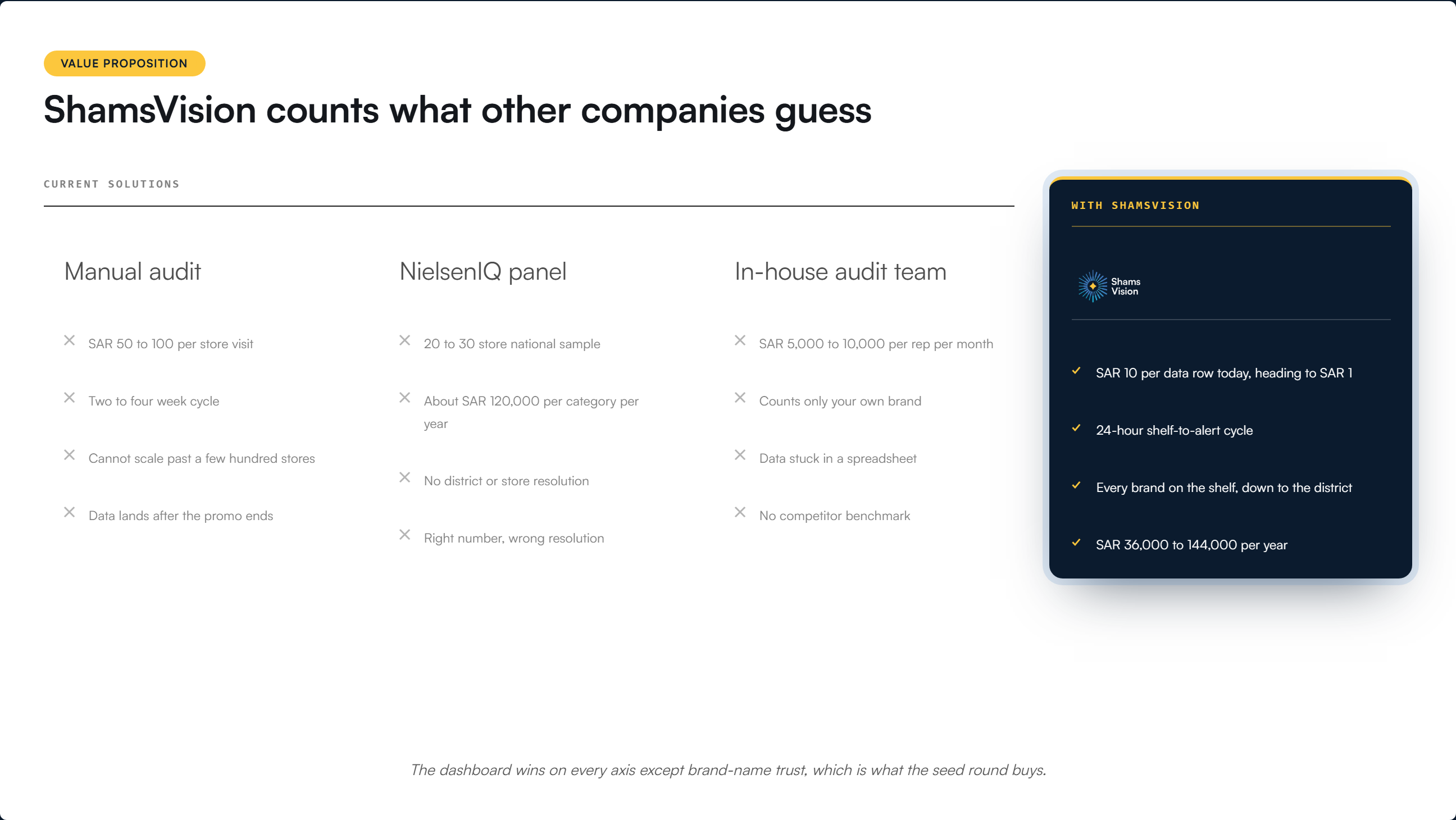
Three alternatives. None of them work for Saudi general trade.
Manual audits cost SAR 50 to 100 a store and take weeks. <a href="https://nielseniq.com">NielsenIQ</a> relies on a national sample projected to the universe, so it has no district detail, on six-figure annual contracts. In-house teams cost SAR 5,000 to 10,000 a rep a month, only count your own brand, and leave the data stuck in a spreadsheet.
ShamsVision is SAR 10 a data row today, a 24-hour cycle, every brand on the shelf, down to the store, for SAR 36,000 to 144,000 a year.
The buyer is weighing all three against one dashboard. It wins on every axis except brand-name trust, which is what the seed round buys. ShamsVision counts what the others guess.
Three alternatives. None of them work for Saudi general trade.
Manual audits cost SAR 50 to 100 a store and take weeks. NielsenIQ relies on a national sample projected to the universe, so it has no district detail, on six-figure annual contracts. In-house teams cost SAR 5,000 to 10,000 a rep a month, only count your own brand, and leave the data stuck in a spreadsheet.
ShamsVision is SAR 10 a data row today, a 24-hour cycle, every brand on the shelf, down to the store, for SAR 36,000 to 144,000 a year.
The buyer is weighing all three against one dashboard. It wins on every axis except brand-name trust, which is what the seed round buys. ShamsVision counts what the others guess.
M 06 / 16
06 of 13
Features
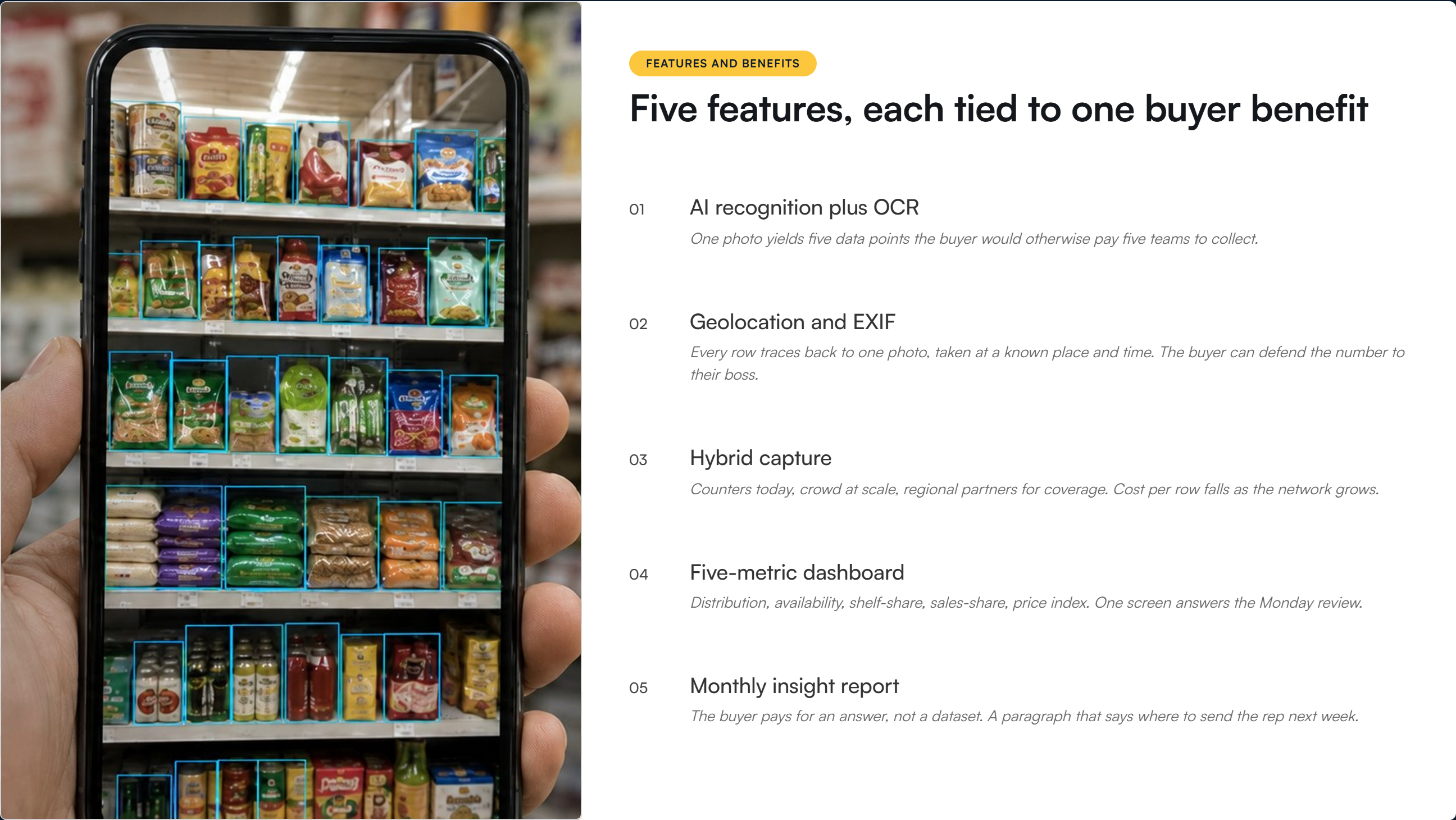
Five features. Each tied to one buyer benefit.
AI recognition plus OCR turns one photo into five data points. Geolocation and EXIF checks make every row traceable, so the buyer can defend it. Hybrid capture, counters then crowd then partners, drives the cost per row from SAR 10 toward SAR 1 as the network grows.
The five-metric dashboard answers the Monday review on one screen: where am I winning shelf, where am I losing it, where are the stockouts, what are competitors charging.
The monthly insight report sells the answer, not the dataset: a paragraph that says where to send the rep next week.
Five features. Each tied to one buyer benefit.
AI recognition plus OCR turns one photo into five data points. Geolocation and EXIF checks make every row traceable, so the buyer can defend it. Hybrid capture, counters then crowd then partners, drives the cost per row from SAR 10 toward SAR 1 as the network grows.
The five-metric dashboard answers the Monday review on one screen: where am I winning shelf, where am I losing it, where are the stockouts, what are competitors charging.
The monthly insight report sells the answer, not the dataset: a paragraph that says where to send the rep next week.
M 07 / 16
07 of 13
Why now
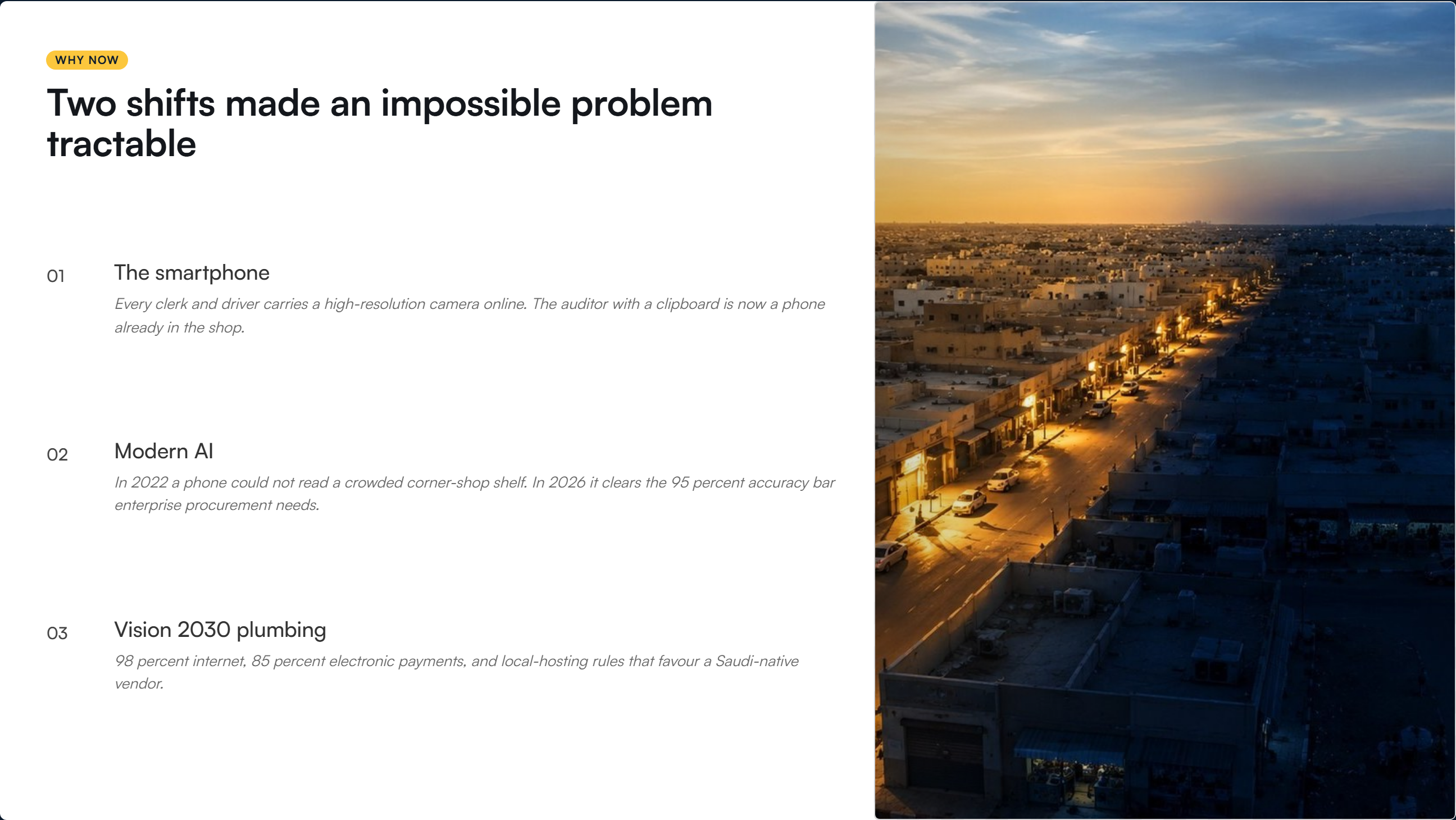
An old impossible problem became tractable in the last three years.
Measuring a corner-shop shelf used to mean sending a trained auditor. Now every clerk and driver carries a smartphone camera, and modern AI can read a crowded shelf at the accuracy enterprise buyers require. Both bottlenecks broke at once.
A photo that used to be a curiosity is now a row of data, and a driver who walked past the aisle is now a paid contributor to a national dataset.
Saudi Arabia built the plumbing too. 98 percent of businesses are online, 85 percent of retail is electronic payments, and local-hosting rules favour a Saudi-native vendor. <a href="https://www.vision2030.gov.sa">Vision 2030</a> makes the market bigger every year.
An old impossible problem became tractable in the last three years.
Measuring a corner-shop shelf used to mean sending a trained auditor. Now every clerk and driver carries a smartphone camera, and modern AI can read a crowded shelf at the accuracy enterprise buyers require. Both bottlenecks broke at once.
A photo that used to be a curiosity is now a row of data, and a driver who walked past the aisle is now a paid contributor to a national dataset.
Saudi Arabia built the plumbing too. 98 percent of businesses are online, 85 percent of retail is electronic payments, and local-hosting rules favour a Saudi-native vendor. Vision 2030 makes the market bigger every year.
M 08 / 16
08 of 13
Market
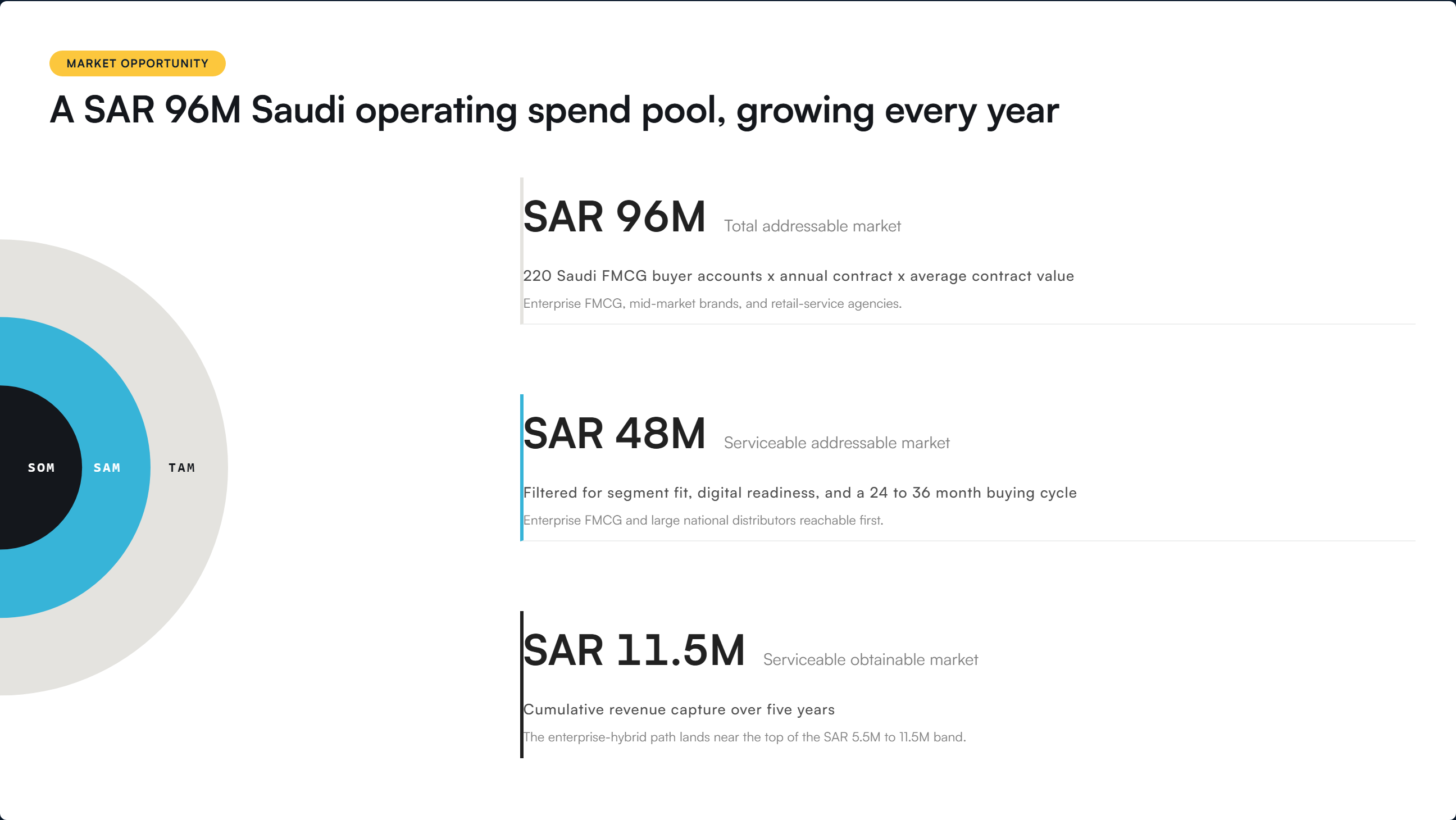
Saudi general trade is a SAR 96 million operating spend pool, and <a href="https://www.vision2030.gov.sa">Vision 2030</a> grows it every year.
Built bottom-up, not top-down. About 220 Saudi FMCG buyer accounts: 80 enterprise brands and national distributors, 100 mid-market brands, and 40 retail-service agencies. At blended contract values they sum to SAR 96 million. The slice reachable in 24 to 36 months is SAR 48 million.
The tailwinds are published, not guessed: Saudi food and beverage growing from SAR 154 billion to SAR 214 billion by 2030, retail revenues up 17 percent year on year per <a href="https://www.stats.gov.sa">GASTAT</a>, and a local-hosting rule that favours a Saudi vendor.
Saudi is the starting point. The GCC and the wider MENA market are the expansion the Series A will be about.
Saudi general trade is a SAR 96 million operating spend pool, and Vision 2030 grows it every year.
Built bottom-up, not top-down. About 220 Saudi FMCG buyer accounts: 80 enterprise brands and national distributors, 100 mid-market brands, and 40 retail-service agencies. At blended contract values they sum to SAR 96 million. The slice reachable in 24 to 36 months is SAR 48 million.
The tailwinds are published, not guessed: Saudi food and beverage growing from SAR 154 billion to SAR 214 billion by 2030, retail revenues up 17 percent year on year per GASTAT, and a local-hosting rule that favours a Saudi vendor.
Saudi is the starting point. The GCC and the wider MENA market are the expansion the Series A will be about.
M 09 / 16
09 of 13
Business model
Three tiers. SAR 3,000, 6,000 and 12,000 a month. Plus services.
Distributors pay SAR 36,000 a year for their own coverage. Regional brands pay SAR 72,000 for national general trade with competitor data. Multinationals pay SAR 144,000 for the full footprint, scorecard and insight report. That is one-half to one-third of <a href="https://nielseniq.com">NielsenIQ</a>.
Services sit on top and get standardised over time. By Year 3 the plan is about 18 customers and SAR 1.08 million in annual recurring revenue, growing to SAR 2.81 million by Year 5.
Each customer is worth about SAR 680,000 against SAR 80,000 to 200,000 to win, a lifetime-to-acquisition ratio above 5. Gross margin reaches 60 percent in Year 2 and 70 by Year 5.
Three tiers. SAR 3,000, 6,000 and 12,000 a month. Plus services.
Distributors pay SAR 36,000 a year for their own coverage. Regional brands pay SAR 72,000 for national general trade with competitor data. Multinationals pay SAR 144,000 for the full footprint, scorecard and insight report. That is one-half to one-third of NielsenIQ.
Services sit on top and get standardised over time. By Year 3 the plan is about 18 customers and SAR 1.08 million in annual recurring revenue, growing to SAR 2.81 million by Year 5.
Each customer is worth about SAR 680,000 against SAR 80,000 to 200,000 to win, a lifetime-to-acquisition ratio above 5. Gross margin reaches 60 percent in Year 2 and 70 by Year 5.
M 10 / 16
10 of 13
Go to market
Asmaa sells direct. Distributors refer. Trade events fill the funnel.
Founder-led for the first 18 months. Asmaa came out of <a href="https://www.loreal.com">L'Oreal</a> trade marketing and <a href="https://www.unilever.com">Unilever</a> supply chain and knows most target trade marketing directors by name. The goal is <a href="#memo-slide-13">three lighthouse pilots</a> in 12 months, each on one tight use case.
Savola, parent of the Panda chain, is the reachable first anchor, with Almarai a larger, harder second; both open the store-permission door and the brand introduction. <a href="https://onegiantleap.com">LEAP</a> and Saudi FoodEx put her in the room with country managers. <a href="https://misa.gov.sa">MISA</a> and <a href="https://www.vision2030.gov.sa">Vision 2030</a> programmes add warm introductions once the first anchor is paying.
The reframe is the whole sale. Not pay for our software, but here is the data your team needs to justify the next merchandising spend. That is how a founder-led enterprise deal closes in nine months instead of eighteen.
Asmaa sells direct. Distributors refer. Trade events fill the funnel.
Founder-led for the first 18 months. Asmaa came out of L'Oreal trade marketing and Unilever supply chain and knows most target trade marketing directors by name. The goal is three lighthouse pilots in 12 months, each on one tight use case.
Savola, parent of the Panda chain, is the reachable first anchor, with Almarai a larger, harder second; both open the store-permission door and the brand introduction. LEAP and Saudi FoodEx put her in the room with country managers. MISA and Vision 2030 programmes add warm introductions once the first anchor is paying.
The reframe is the whole sale. Not pay for our software, but here is the data your team needs to justify the next merchandising spend. That is how a founder-led enterprise deal closes in nine months instead of eighteen.
M 11 / 16
11 of 13
Team
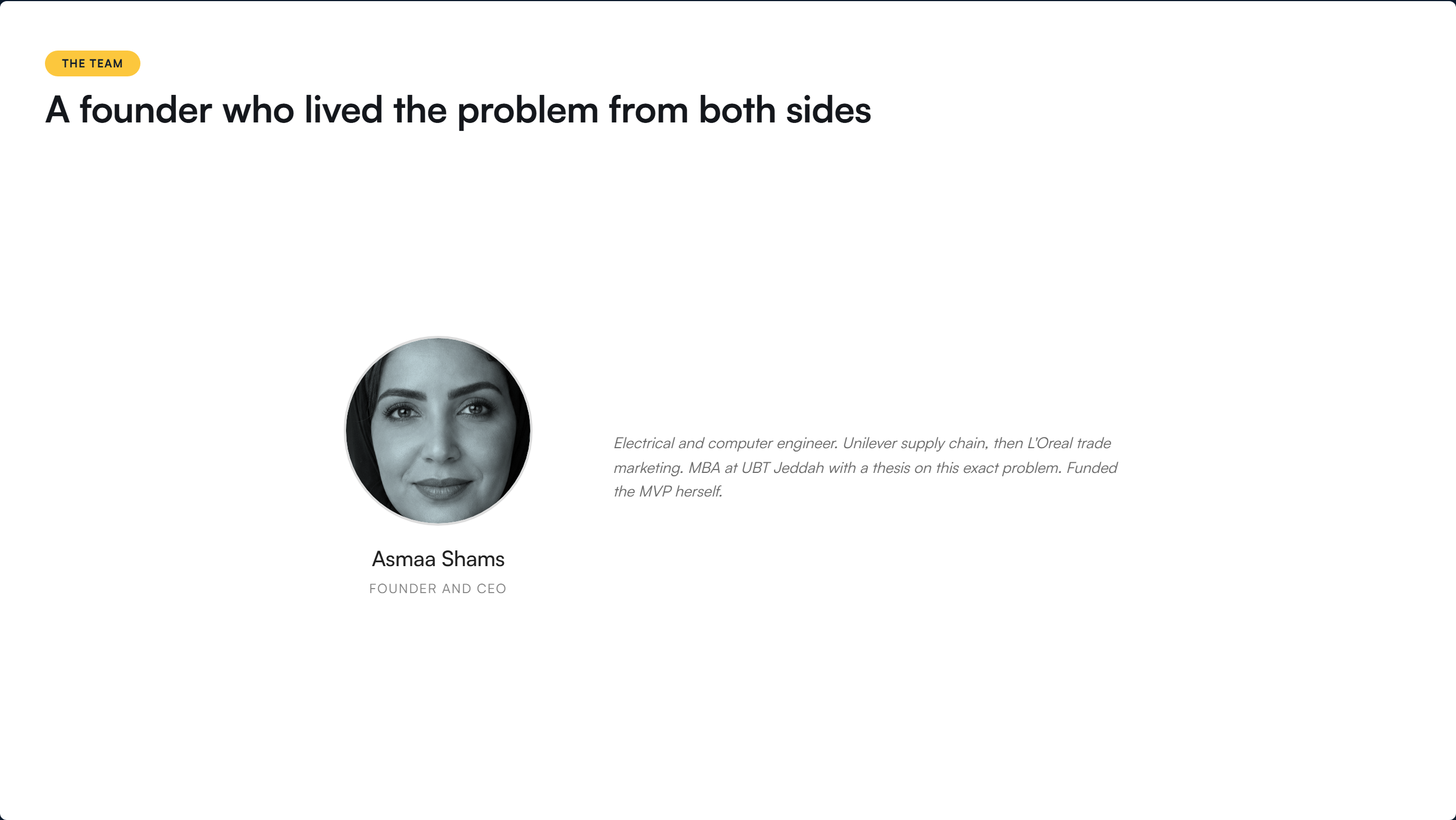
Asmaa Shams. Engineer. Supply-chain operator. Trade marketer. MBA. Solo founder. Saudi.
An electrical and computer engineering degree, then <a href="https://www.unilever.com">Unilever</a> supply chain, where she learned how modern trade is measured. Then <a href="https://www.loreal.com">L'Oreal</a> trade marketing, where she watched her team make data-driven calls in the chains and educated guesses in general trade, on the same brands in the same week.
She wrote her UBT Jeddah MBA thesis on this problem, then called <a href="https://traxretail.com">Trax</a> pretending to be a buyer to learn how the incumbent prices and where it cannot reach. Then she funded the MVP herself, and is still burning her own capital. There is no outside money in yet.
A <a href="https://www.globalshapers.org">World Economic Forum Global Shaper</a>, based in Jeddah, with family across the Gulf.
Asmaa Shams. Engineer. Supply-chain operator. Trade marketer. MBA. Solo founder. Saudi.
An electrical and computer engineering degree, then Unilever supply chain, where she learned how modern trade is measured. Then L'Oreal trade marketing, where she watched her team make data-driven calls in the chains and educated guesses in general trade, on the same brands in the same week.
She wrote her UBT Jeddah MBA thesis on this problem, then called Trax pretending to be a buyer to learn how the incumbent prices and where it cannot reach. Then she funded the MVP herself, and is still burning her own capital. There is no outside money in yet.
A World Economic Forum Global Shaper, based in Jeddah, with family across the Gulf.
M 12 / 16
12 of 13
Competitive advantage
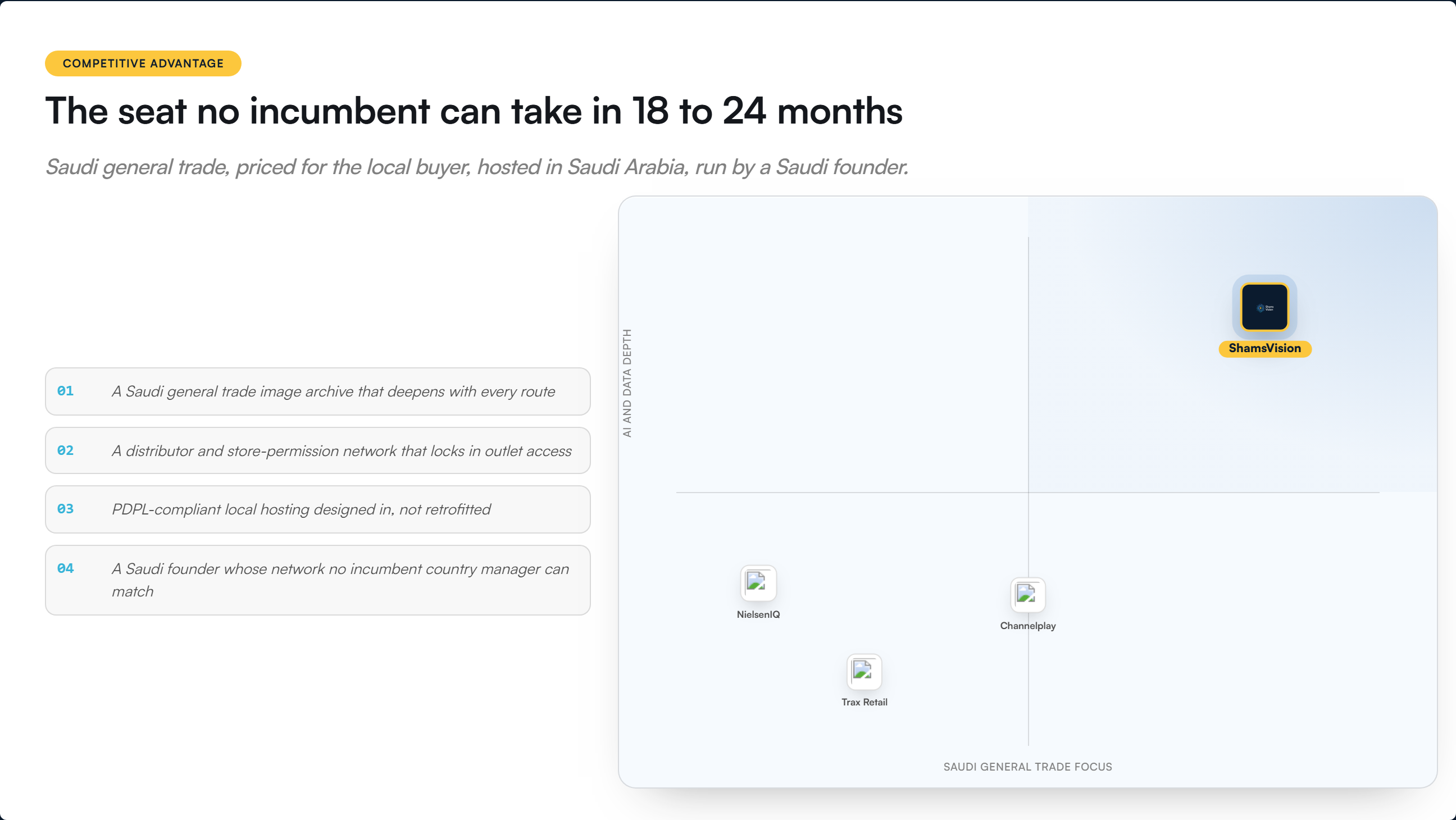
Three named competitors. None of them eats Saudi general trade in 18 to 24 months.
NielsenIQ is the global leader, but its general trade number comes from a projected national sample and its image model is built for supermarket lighting. Trax has the recognition engine, but its economics assume clean chain shelves and big contracts. Channelplay is a global field-execution firm that only entered the GCC in 2024 with a few hundred regional staff, and it sells labour, not AI.
Each could build a Saudi general trade product. Each would have to fight its own pricing and stand up a Saudi team to do it. That is the window.
ShamsVision wins by taking the seat none of them can sit in: Saudi general trade, priced for the local buyer, hosted in Saudi Arabia, run by a Saudi founder. The moat is the compounding image archive, the distributor network, local hosting, and a founder no country manager can replicate.
Three named competitors. None of them eats Saudi general trade in 18 to 24 months.
NielsenIQ is the global leader, but its general trade number comes from a projected national sample and its image model is built for supermarket lighting. Trax has the recognition engine, but its economics assume clean chain shelves and big contracts. Channelplay is a global field-execution firm that only entered the GCC in 2024 with a few hundred regional staff, and it sells labour, not AI.
Each could build a Saudi general trade product. Each would have to fight its own pricing and stand up a Saudi team to do it. That is the window.
ShamsVision wins by taking the seat none of them can sit in: Saudi general trade, priced for the local buyer, hosted in Saudi Arabia, run by a Saudi founder. The moat is the compounding image archive, the distributor network, local hosting, and a founder no country manager can replicate.
M 13 / 16
13 of 13
Roadmap
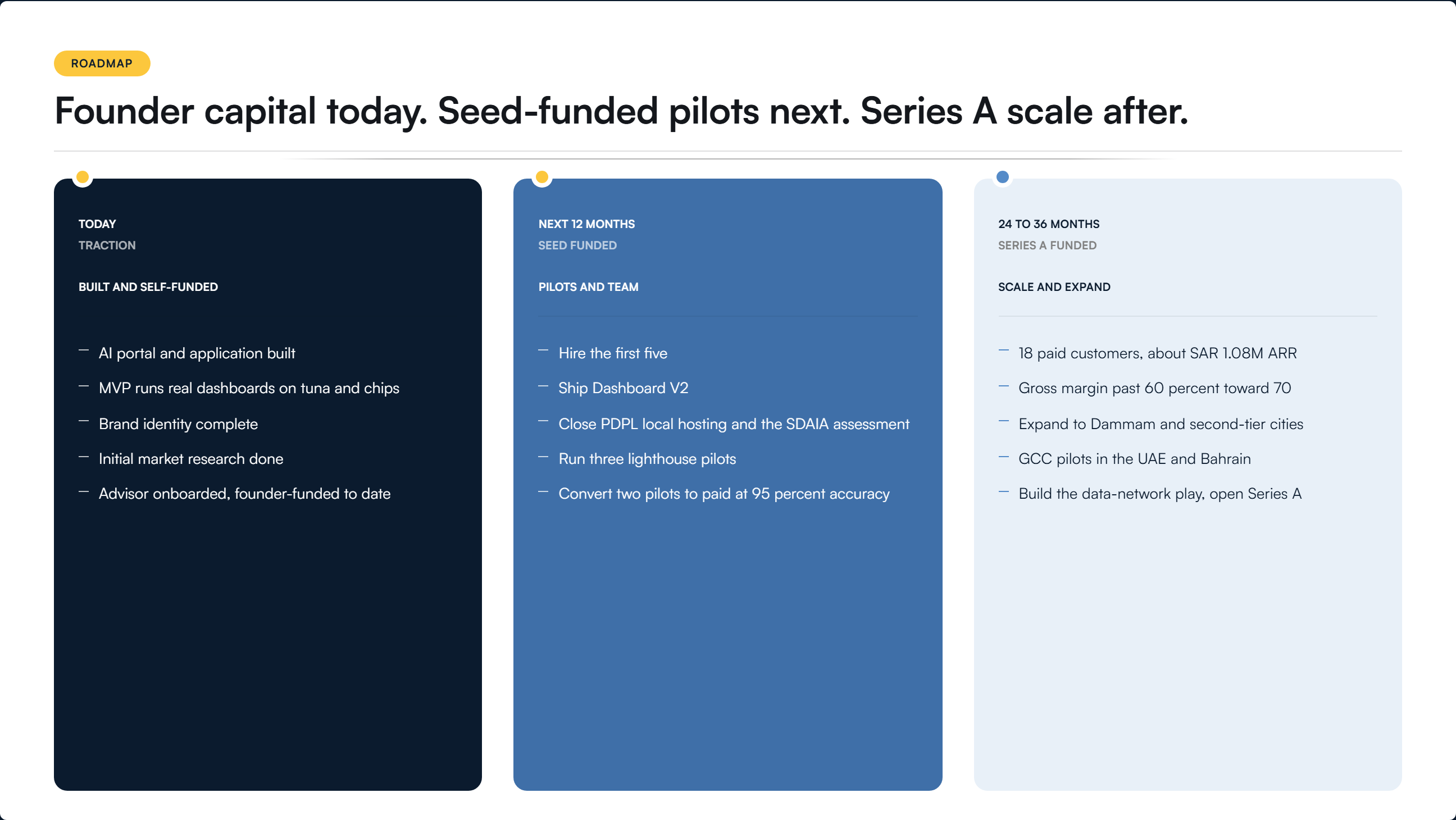
Today: MVP, brand, two categories analysed, founder capital. Nothing more.
No pilots yet and no paying customers, and that is the honest framing. What is real: the AI portal and app are built, the MVP runs on canned tuna and chips, the brand is done, and the founder has funded it all.
The seed-funded year: hire the first five, ship <a href="#memo-slide-4">Dashboard V2</a>, close local hosting, run three lighthouse pilots and convert two to paid at 95 percent accuracy. Then Series A scale to 18 customers, higher margins and the first GCC pilots.
Two risks shape the plan: a six-to-nine-month enterprise sales cycle the seed must outlast, and AI accuracy that has to hold beyond tuna and chips. The biggest near-term milestone is the first technical hire. Everything builds on it.
Today: MVP, brand, two categories analysed, founder capital. Nothing more.
No pilots yet and no paying customers, and that is the honest framing. What is real: the AI portal and app are built, the MVP runs on canned tuna and chips, the brand is done, and the founder has funded it all.
The seed-funded year: hire the first five, ship Dashboard V2, close local hosting, run three lighthouse pilots and convert two to paid at 95 percent accuracy. Then Series A scale to 18 customers, higher margins and the first GCC pilots.
Two risks shape the plan: a six-to-nine-month enterprise sales cycle the seed must outlast, and AI accuracy that has to hold beyond tuna and chips. The biggest near-term milestone is the first technical hire. Everything builds on it.
M 14 / 16
Appendix
Forecast
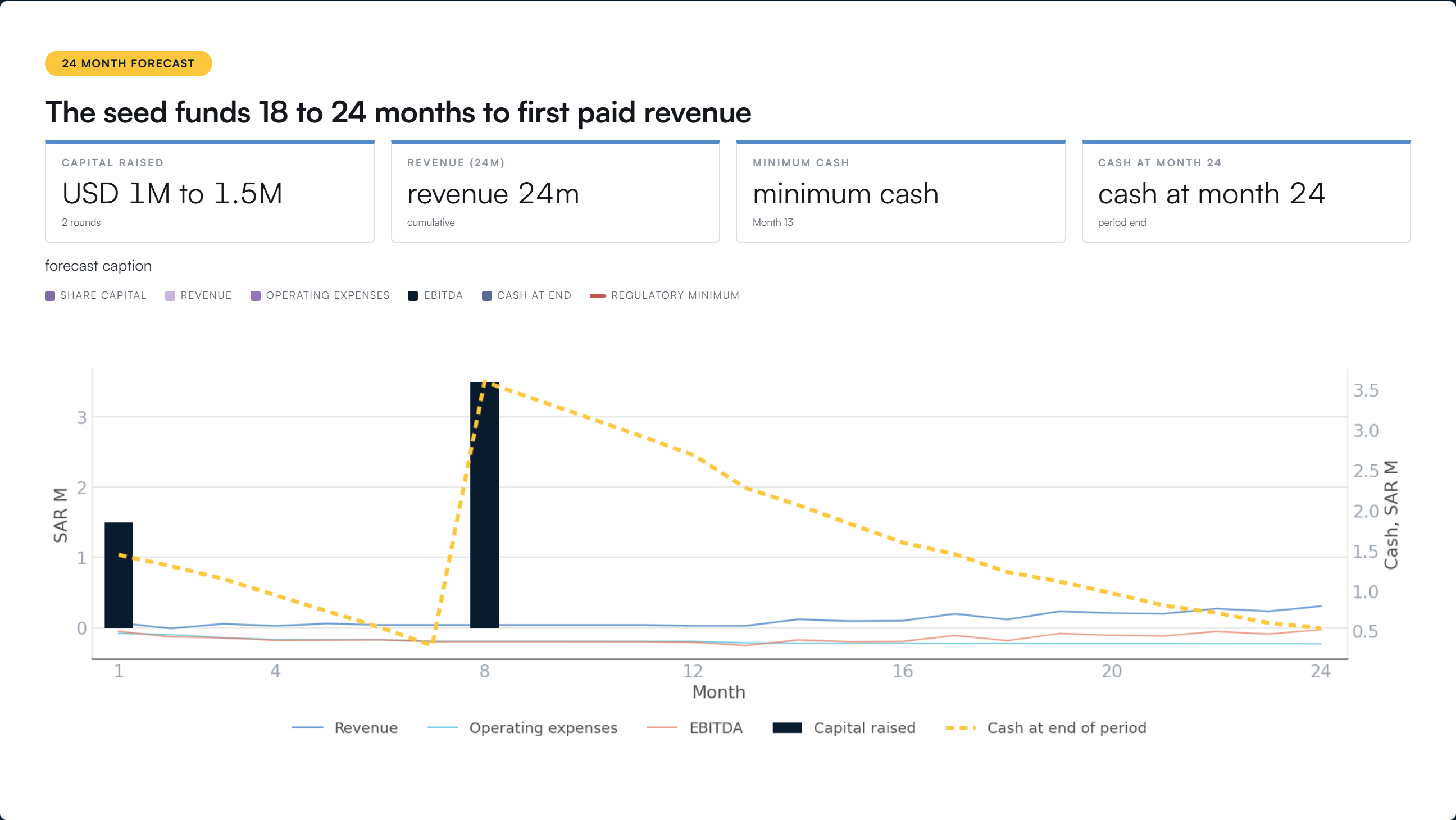
The seed buys 18 to 24 months: <a href="#memo-slide-13">three pilots</a>, two paid conversions, and the first real revenue.
Year 1 is small on purpose, about SAR 252,000, because a Saudi enterprise sale runs six to nine months. By Year 3 the plan is roughly 18 customers and SAR 1.08 million in <a href="#memo-slide-9">annual recurring revenue</a>, reaching SAR 2.81 million by Year 5. Five-year cumulative revenue lands near SAR 11.5 million.
Gross margin climbs from about 60 percent in Year 2 toward 70 by Year 5. Each customer is worth about SAR 680,000 against SAR 80,000 to 200,000 to win. Payback is under 18 months and break-even arrives in Year 3.
The raise is USD 1 to 1.5 million: roughly 60 percent team, 25 percent product, 10 percent commercial, 5 percent reserve. If pilots close faster the runway extends; if procurement runs nine months it tightens. The seed is sized for the longer case.
The seed buys 18 to 24 months: three pilots, two paid conversions, and the first real revenue.
Year 1 is small on purpose, about SAR 252,000, because a Saudi enterprise sale runs six to nine months. By Year 3 the plan is roughly 18 customers and SAR 1.08 million in annual recurring revenue, reaching SAR 2.81 million by Year 5. Five-year cumulative revenue lands near SAR 11.5 million.
Gross margin climbs from about 60 percent in Year 2 toward 70 by Year 5. Each customer is worth about SAR 680,000 against SAR 80,000 to 200,000 to win. Payback is under 18 months and break-even arrives in Year 3.
The raise is USD 1 to 1.5 million: roughly 60 percent team, 25 percent product, 10 percent commercial, 5 percent reserve. If pilots close faster the runway extends; if procurement runs nine months it tightens. The seed is sized for the longer case.
M 15 / 16
The ask
Ask
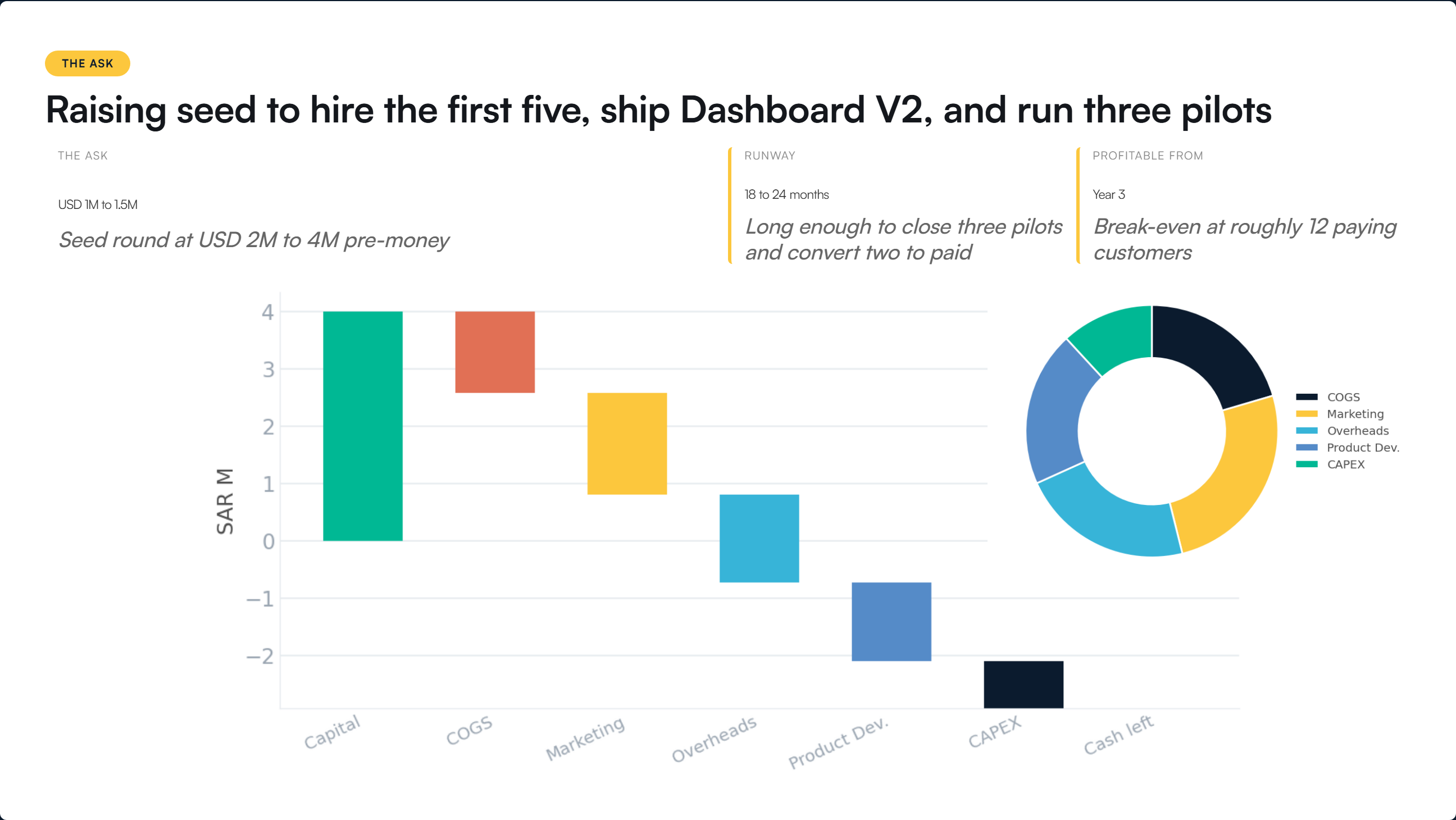
Raising a USD 1 to 1.5 million seed to hire the first five, ship <a href="#memo-slide-4">Dashboard V2</a>, close local hosting and run <a href="#memo-slide-13">three pilots</a>.
Pre-money is USD 2 to 4 million, cross-checked four ways: the Berkus, scorecard, risk-factor and venture capital methods all bracket the same range. The final number gets set once the model is signed off.
Runway is 18 to 24 months, enough to close <a href="#memo-slide-13">three pilots</a>, convert two, and reach a Series A in 2027 with paying enterprise customers. The ideal lead is comfortable with Saudi seed risk, has an enterprise B2B AI thesis, and can open doors into Saudi FMCG. A solo founder out of L'Oreal and Unilever, Asmaa is candid that she is building her first team: the first GTM hire is a partnership and distribution lead, so a lead investor who helps recruit and introduce country managers and a commercial director is worth more than the cheque alone.
The thesis is one line: Saudi general trade has been measurable for two years and nobody has built the Saudi-native company to measure it. The seed funds the team and pilots that turn an 18 to 24 month window into a lead.
Raising a USD 1 to 1.5 million seed to hire the first five, ship Dashboard V2, close local hosting and run three pilots.
Pre-money is USD 2 to 4 million, cross-checked four ways: the Berkus, scorecard, risk-factor and venture capital methods all bracket the same range. The final number gets set once the model is signed off.
Runway is 18 to 24 months, enough to close three pilots, convert two, and reach a Series A in 2027 with paying enterprise customers. The ideal lead is comfortable with Saudi seed risk, has an enterprise B2B AI thesis, and can open doors into Saudi FMCG. A solo founder out of L'Oreal and Unilever, Asmaa is candid that she is building her first team: the first GTM hire is a partnership and distribution lead, so a lead investor who helps recruit and introduce country managers and a commercial director is worth more than the cheque alone.
The thesis is one line: Saudi general trade has been measurable for two years and nobody has built the Saudi-native company to measure it. The seed funds the team and pilots that turn an 18 to 24 month window into a lead.
M 16 / 16